Assessment and Reporting
The assessment process in place at TC includes continuous and summative reporting to our community. Students are assessed on their work and study habits, academic achievement, and academic progress.
The elements of our reporting in include:
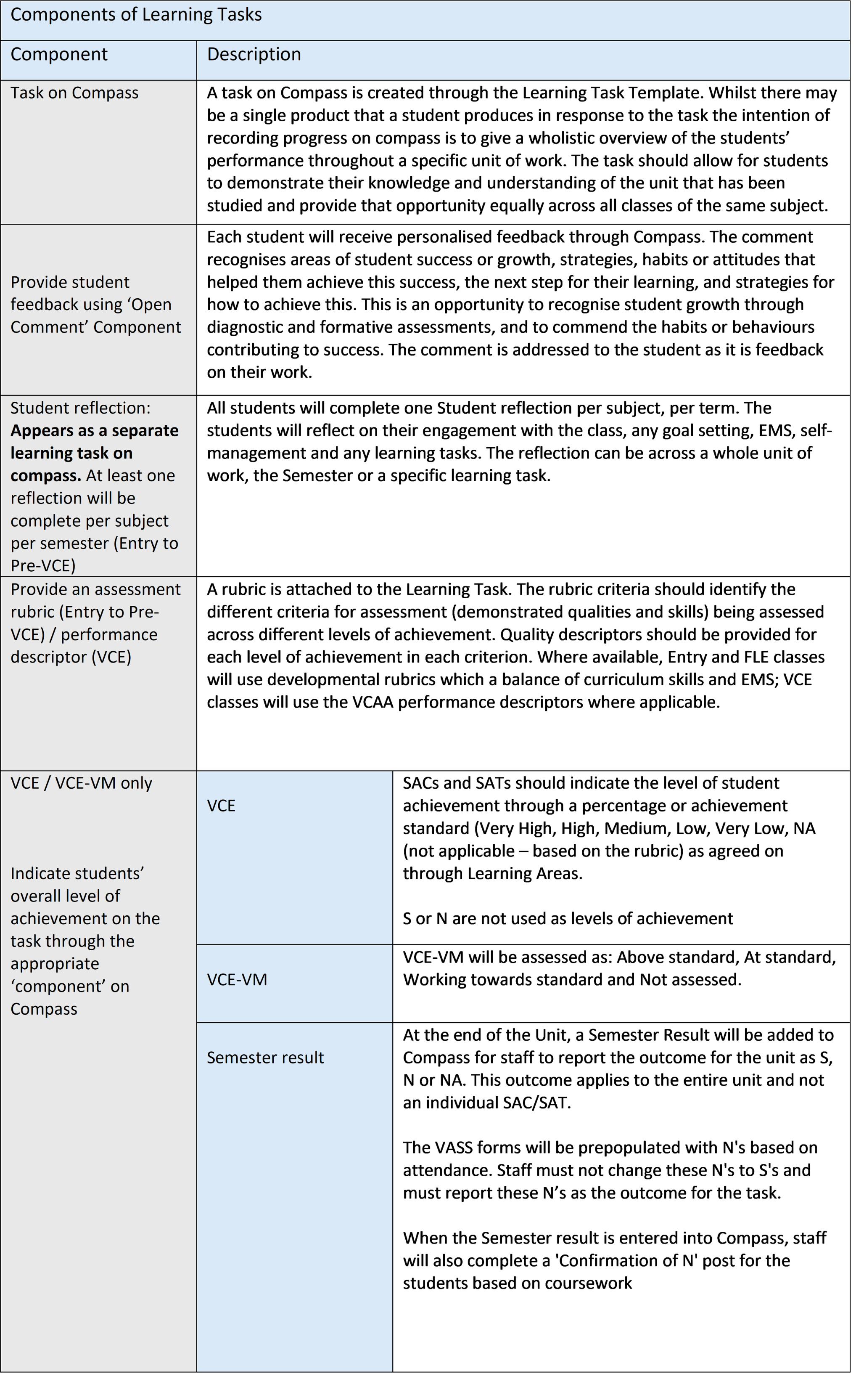
All components will be created, completed and published through Compass Reporting.
WASHI
WASHI – Work and Study Habits Index
Students receive feedback on their work and study habits (WASHI) from each of their teachers twice per term (approximately every five weeks). The purpose of the WASHI is to provide continuous and timely feedback to students and families on what staff are seeing in the classroom from their students.
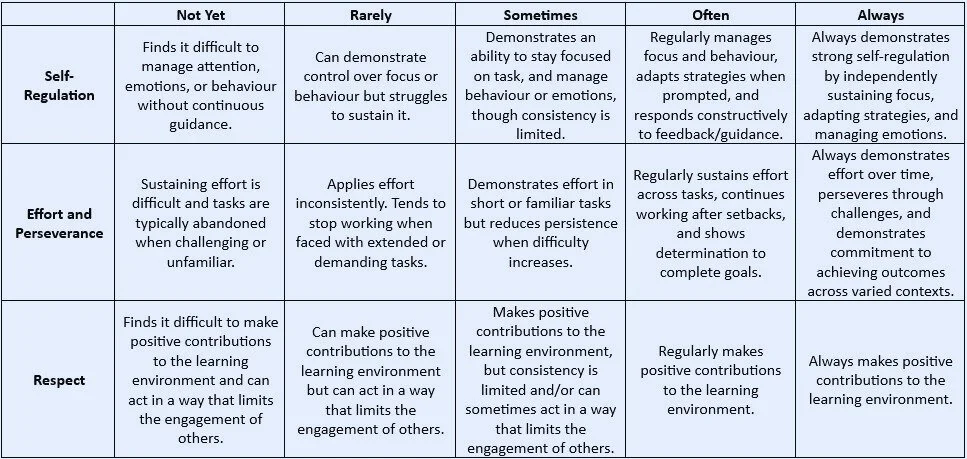
Students are assessed against the following criteria: Self-Regulation, Effort and Perseverance, and Respect:
Self-Regulation encompasses students’ ability to manage their focus and emotions in the classroom.
Effort and Perseverance addresses the ability of students to continue to apply themselves even when classroom activities are challenging or unfamiliar.
Respect refers to the preservation of a safe and encouraging learning environment, including how students treat each other, staff, and the space.
For each criteria, students receive a descriptor based on frequency – ‘Not Yet’, ‘Rarely’, ‘Sometimes’, ‘Often’ and ‘Always’.
Always (4)
Often (3)
Sometimes (2)
Rarely (1)
Not Yet (0)
For the first time, attendance data in the form of the in-class percentage will also be reflected in the WASHI. The in-class percentage measures the number of times a student is physically present in the classroom, indicating the amount of teaching and learning a student is exposed to in each of their classes in the five-week period being assessed. Attendance will therefore not be cumulative and will instead be a snapshot of the 5-week period. This is a valuable metric for students who are seeking to improve their WASHI scores and academic achievements, as well as for families, our Community Executive Teams (CET) and teaching staff.
Our updated WASHI reflects what is important for our students to know about their performance separate from academic results. Our TC values are captured within the new criteria and will allow students to reflect meaningfully on their experiences in class and how they are continuing to achieve at TC with a growth mindset.
Learning data – such as Learning Task comments, or results of tests such as PAT – are reported on through other means on Compass and are not incorporated into WASHI.
Expectations for each criteria in WASHI are outlined in the rubric below. Staff will refer to this while completing WASHI, and students should refer to this when reflecting on their WASHI scores.
Semester Reports and Learning Tasks
We employ a continuous approach to assessment and reporting, providing timely written feedback (2 weeks for Entry and FLE subjects, 3 weeks for VCE subjects) on summative assessment. Summative feedback is provided to students and families on a continuous basis through Compass. Continuous reporting feedback is compiled at the end of each semester for end of semester reports.
Each learning task will have a rubric uploaded as an attachment to the learning task on Compass and is also available to parents as an attachment in the Compass feedback.
Semester reports include:
Three Learning Tasks OR relevant number of SACs per class: Task descriptions and learning task comments (achievement standard only to be included for VCE)
One student reflection per non-VCE class – this will appear as a separate task. Staff can provide 2-3 guiding questions or leave the space open for students to reflect on their progress in the subject. Students are encouraged to reflect on their learning tasks, WASHI feedback and EMS/attendance goals in this student reflection.
The Victorian Curriculum Levels (based on achievement standards) OR VCE Satisfactory/Not Satisfactory levels.