
Student Assessment, Reporting and Data Policy

Approved By: Principal
Date of Review: October 2026
Page Contents
Policy
Assessment at Templestowe College
Assessment and Reporting Schedule
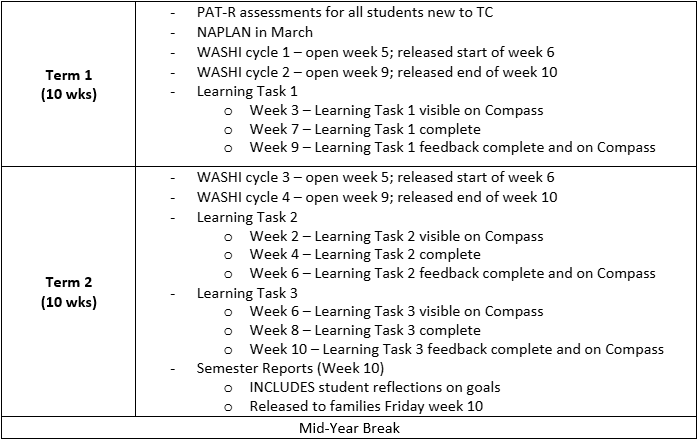
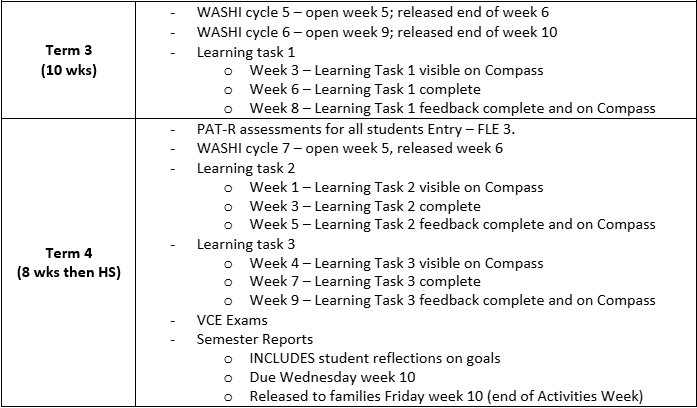
This schedule is intended to support staff to keep up with their workload and assessment and reporting cycles. The schedule is designed to give timely feedback to students and parents as to learning progress in each subject.
Work and Study Habits Index (WASHI)
*NOTE: We have undertaken a review into the WASHI and will be relaunching a newer version in Term One. This is still being set up on Compass, but the following updates are of note:
The purpose of the WASHI
The purpose is to provide timely, relevant feedback to students and parents on behaviours observed in the classroom relating to students’ approach to their learning.
The new areas being assessed are based on feedback from staff regarding what information they think students and families need to know, as well as being informed by Berry Street, concepts such as the growth mindset, and information separate to academic performance (which is measured by other means).
The updated version of the WASHI will aim to include attendance data, so that this is regularly shared with families.
The learning behaviours will be measured in a more tangible way – looking at frequency rather than more subjective measures (not yet, rarely, sometimes, often, always)
Students will use their WASHI to reflect on their approach to their learning and help them to set goals for themselves in class, building on the goal-setting that we launched in 2025
The data gathered
This is used to measure changes in students’ approach to their learning.
This is also used in SSG meetings by CET when discussing student progress and developing ILPs.
The frequency of the WASHI
Twice per term, with meeting time to be used to complete the first in a semester cycle.
‘Fill from previous cycle’ will be available after the first WASHI is complete to make the process easier for staff to track student learning habits
This will reduce the need for CET to seek additional feedback from staff on student behaviour and learning habits.
Expectations for each criteria in WASHI are outlined in a matrix, to be circulated at the start of the year. Staff should refer to these when compiling their WASHI feedback, and students should refer to this when reflecting on their WASHI scores.
Semester Reports and Learning Tasks
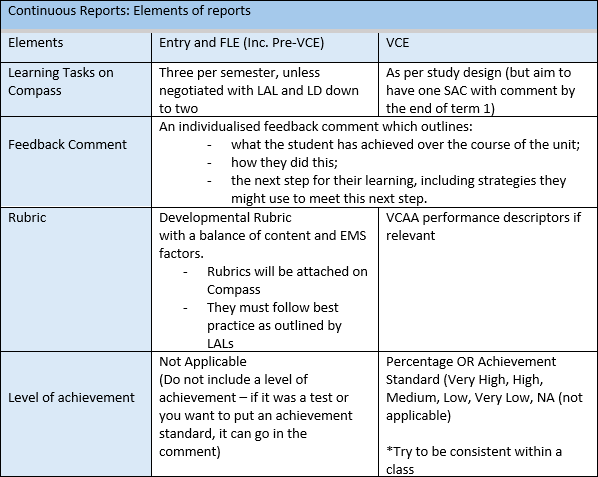
We employ a continuous approach to assessment and reporting, providing timely written feedback (2 weeks for Entry and FLE subjects, 3 weeks for VCE subjects) on summative assessment. Summative feedback is provided to students and families on a continuous basis through Compass. Continuous reporting feedback is compiled at the end of each semester for end of semester reports.
Each learning task will have a rubric uploaded as an attachment to the learning task on Compass and is also available to parents as an attachment in the Compass feedback.
Semester reports include:
3 Learning Tasks OR relevant number of SACs per class: Task descriptions and learning task comments (achievement standard only to be included for VCE)
1 student reflection per non-VCE class – this will appear as a separate task. Staff can provide 2-3 guiding questions or leave the space open for students to reflect on their progress in the subject. Students are encouraged to reflect on their learning tasks, WASHI feedback and EMS/attendance goals in this student reflection.
The Victorian Curriculum Levels (based on achievement standards) OR VCE Satisfactory/Not Satisfactory levels.
Expanded Measures of Success
In addition to being assessed against the Victorian Curriculum, Entry and FLE students are also assessed against our Expanded Measures of Success.
The expanded measures of success recognise students’ ability to demonstrate capacity in the following areas.
Working with Others
Independence
Creative Thinking
Active Citizenship
Technology
Students will have their EMS capability reported on using the Continuum in Compass. This can viewed by students, parents and staff via the student profile page.


-
Working with others is the ability to cooperate as part of a team towards a common goal. It is productive, encouraging, respectful and inclusive.
People demonstrate working with others when they understand their role in a team and are able to effectively listen, share, critique, support, provide and act on feedback.
-
Participating (me as a group member)
Leading others (me as a group leader)
Supporting others (me as a group facilitator)
-
Independence is the ability for students to set their own goals and pursue their projects. Independence comes from completing repeated actions, to build positive working habits. An independent learner understands their roles and responsibilities. In doing so, the student completes their work in a timely way.
People demonstrate their ability to be independent when they set personal goals, have sustained motivation, adapt to challenges and incorporate feedback to improve their skills.
-
Self-managing
Goal setting
Reflecting
-
Active citizenship enables us to connect and empathise with different perspectives and experiences, and consider our role in society. This includes ethical problem-solving, engaging with social and cultural issues, and working towards a sustainable future.
People demonstrate active citizenship when they show understanding of local and global challenges and experiences, advocate for others, and participate in making the world a better place.
-
Understanding of different perspectives or issues
Advocating
Participating in helping people or causes
-
Technology assists us to be creative, communicate with others, source and organise knowledge in subject areas, professions, and passions. The use of technology is meaningful and relevant to the task and assist the user to be successful.
People demonstrate their ability to use technology when they can effectively apply a range of digital and manual methods to create products, innovate ideas as well as communicate, find and organise information.
-
Creating using technology (digital and manual)
Communicating using technology
Organising using technology
-
Creative thinking requires critical analysis and reasoning to form independent judgements.
It includes considering multiple perspectives with an open mind.
People demonstrate creative thinking when they can identify challenges, issues or opportunities and apply a step-by-step process to add value towards a solution.
-
Analysing problems (critical thinking)
Finding solutions
(creative thinking
Implementing solutions
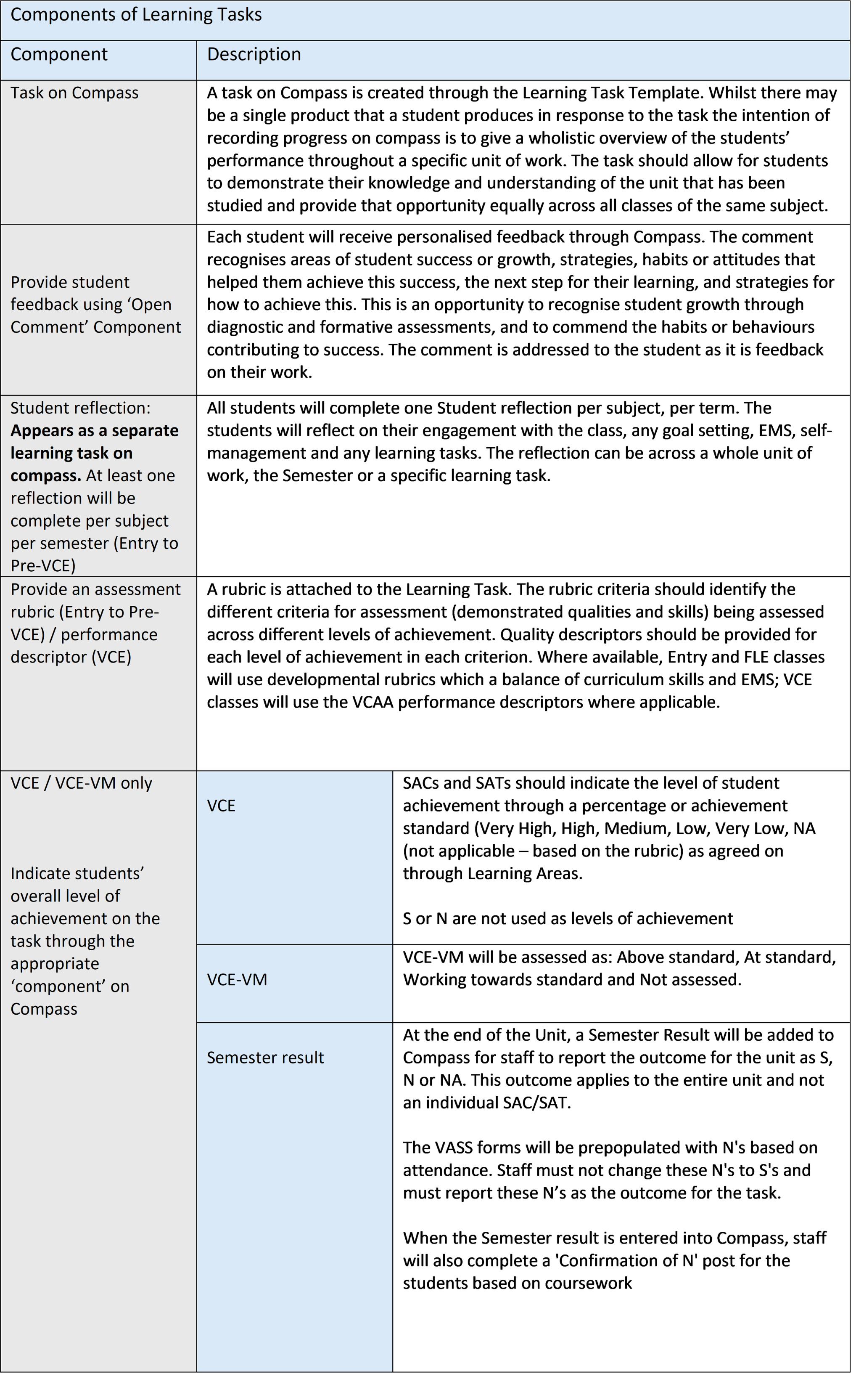
Components of Learning Tasks
Communication of this policy
This policy will be communicated to our school community in the following ways:
Available publicly on the school website
Included in staff induction processes
Included in transition correspondence to new families
Discussed at staff briefings/meetings as required
Discussed at parent information nights/sessions as required
Annually referenced in Next Week @TC
Hard copy available from school administration upon request
Further information and resources
Related TC Resources: